




How to slow-roast prime rib
Our guide to a slow-roasted prime rib for the holiday table.

Most steak fans have had pan-seared steak—probably multiple times, even. A pan-seared steak can give you the same golden-brown crust as the grill, but it can also be a more convenient way to cook steak quickly than firing up and dirtying the grill. If you’re interested in learning how to pan-sear steak to perfection, this is the guide you need to read and bookmark.
There are two important things to remember when choosing a steak cut to pan-sear.
First, choose boneless. Bone-in steaks are great, but they’re better used for oven-cooked steaks. When you sear a steak in a pan, the bone can actually get in the way of the searing process, as the meat closest to the bone typically doesn’t come into contact with the pan like it needs to sear.
Second, pick a cut that’s tender. If you choose steak that benefits from a slow-cooking method to tenderize, like chuck steak, it won’t have enough time to do so through pan-searing unless you don’t mind spending extra time finishing your steak off in the often.
Which steak cuts meet these criteria? Ribeye, filet mignon, and sirloin are all top-tier choices. They are super tender on their own, so they don’t need a bunch of low-heat slow-cooking to tenderize. Plus, you can get boneless versions of all three that are perfect for the pan.
Pan-seared steak needs high, consistent heat to cook properly, so it’s important to get a pan that can stand up to those high temperatures. A top choice for steak enthusiasts is a cast-iron skillet, which holds and withstands heat extremely well. This is an especially good option if you have a really thick piece of steak that might need a few minutes in the oven to finish cooking after searing. You can transfer a cast-iron pan directly into the oven, so there’s no need to switch to a new pan and dirty more dishes.
Another popular option is a carbon steel pan. Carbon steel pans are much lighter than cast-iron pans, so if you struggle to maneuver a cast-iron pan on the stove, a carbon steel pan could be a better option. It’s also generally easier to clean a carbon steel pan, which you can clean about the same way as you would other pans and cooking tools.
To pan sear steaks, you’ll need your skillet, oil, a pat of butter, and seasonings. And, if you plan to cook your steak past medium-rare or have an especially thick steak, you might also need your oven.
To start, add salt to both sides of the steak. Then rest it at room temperature for 30-45 minutes to allow the salt to brine the steak and let the steak’s temperature rise slightly for more even cooking. During the last five minutes of resting, preheat the skillet with oil.
Season the steak with any other seasonings you choose, like black pepper and garlic powder. Transfer the steak to the skillet to sear for 2-3 minutes. It’s ready to flip to the other side once it’s become a crisp golden-brown color. Then, sear for another 2-3 minutes.
Add the butter to the pan and let it melt. Lower the heat and continue cooking for 3-5 minutes. Continuously spoon the butter over the top of the steak, which keeps it moist and helps the inside cook evenly to the proper temperature. Your steak is ready to come off the heat when it reaches 125-130℉.
Finally, transfer the steak to a clean plate or cutting board. Tent it loosely with foil while it rests for 10 minutes.
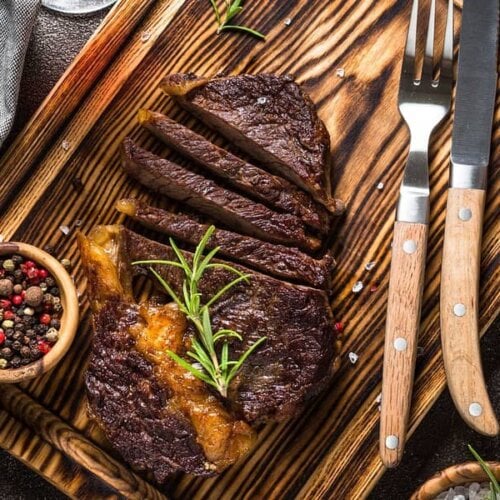
Try this simple pan-seared steak recipe to learn the proper technique for searing steak on the stove.
You can use other steaks for this method, like sirloin, filet mignon, or strip steak. However, the thickness of your steak may require you to adjust your cooking times. Our recipe is designed for a ribeye that’s about 1 ½ inches thick. Cook for less time if your steak is thinner and more time if your steak is thicker (+/- 1-3 minutes, generally).
Per Serving (based on 4 servings, based on a 2,000-calorie daily diet)
| Nutrient | Amount (% Daily Value (DV)) |
|---|---|
| Calories | 480 (24%) |
| Total Fat | 38g (49%) |
| Saturated Fat | 15g (75%) |
| Trans Fat | 1g |
| Cholesterol | 120mg (40%) |
| Sodium | 550mg (24%) |
| Total Carbohydrate | 0g (0%) |
| Dietary Fiber | 0g (0%) |
| Total Sugars | 0g |
| Added Sugars | 0g (0%) |
| Protein | 34g (68%) |
| Vitamin D | 0.2mcg (1%) |
| Calcium | 18mg (1%) |
| Iron | 2.8mg (16%) |
| Potassium | 480mg (10%) |
We suggest pan-searing steak to medium-rare, as this level of doneness typically brings out the best texture and flavor from steak. Cooking past medium-rare can result in more chew, but we’re also aware that people prefer their steak differently.
The guidelines in this article focus on a medium-rare cook. To cook your steak past medium-rare, add about 3-5 minutes to the cooking process for each level of doneness. For example, for medium, you’d add 3-5 minutes, and for well-done, you’d add about 9-15 minutes.
More importantly, reference the steak temperature chart below to determine the final temperature of your steak for your level of doneness. We’ve also included a temperature range your steak should meet when it’s ready to be removed from the heat to rest, as steak continues to cook when resting.
| Steak Doneness | Final Temperature | Remove from Heat |
| Rare | 120-125℉ | 115-120℉ |
| Medium-rare | 130-135℉ | 125-130℉ |
| Medium | 140-145℉ | 135-140℉ |
| Medium-well | 150-155℉ | 145-150℉ |
| Well-done | 160-165℉ | 155-160℉ |
An instant-read thermometer is the most accurate tool to gauge the internal temperature of your steak. Insert the thermometer’s probe into the thickest part of the steak until it reaches the middle portion. Compare that temperature with the chart above to determine whether your steak is ready to remove from the heat or has reached its final temperature.
Pan-seared steaks pair well with all kinds of side dishes, especially those that match steak’s bold and savory flavors. For example, garlic mashed potatoes are a staple side dish, with their creamy texture offsetting the chew of a pan-seared steak. People also enjoy grilled asparagus and sauteed mushrooms and onions with steak dishes.
You can opt for a lighter side dish, too, like a crisp, fresh salad or a more savory caprese salad. Or grill corn on the cob or roast Brussels sprouts.
For more side dish inspiration, check out our numerous steak side dish recipes and guides.
If you’ve followed the recipe and instructions above but still want a few more tricks up your sleeve for cooking the best pan-seared steak, we don’t blame you. Here’s what you need to know:
Getting a quality cut of steak is almost as important as the actual cooking process you use. Look for steak that’s freshly cut — ask the butcher when it was cut or have them cut some for you. It should have a good amount of marbling and be deep red in color. If possible, choose USDA Choice or USDA Prime cuts, which are top-tier categories of steak in the U.S.
Once you bring it home, keep your steak in the refrigerator until you’re ready to cook it. Store it on the bottom shelf of the refrigerator, keeping it on a plate to prevent drippings from making their way into your fridge. Also, keep the steak’s wrapper on until you’re ready to cook with it to prevent air from getting to it.

Pan-seared steak can be an excellent addition to your meal prep ideas. And, yes, leftover steak is fine to eat as long as you eat it within 3-4 days. So, meal prep 3-4 days of steak meals at a time to avoid waste. Here are a few steak meal prep ideas:
After you pan-sear your steak, let it rest for at least 10 minutes. Then, slice it to divide between your meals. Remember that just 3 ounces of steak counts as a serving, which contains about 20 grams of protein. Adjust your portion size accordingly to match your protein and calorie needs.
Pan-seared steak is one of the most common methods to use when cooking steak, right up there with grilling. It’s a must to have in your knowledge bank if you plan to cook steak regularly or even on occasion. When you can perfect a pan-seared steak, you have the skills needed to branch off into other cooking methods and more advanced steak dishes.
Browse Chicago Steak Company’s mail-order steaks to find high-quality, dry-aged beef, hand-cut and packaged for every customer.


Our guide to a slow-roasted prime rib for the holiday table.
Our guide to baking a ham for Christmas dinner.


Leave a comment
This site is protected by hCaptcha and the hCaptcha Privacy Policy and Terms of Service apply.