




How to slow-roast prime rib
Our guide to a slow-roasted prime rib for the holiday table.

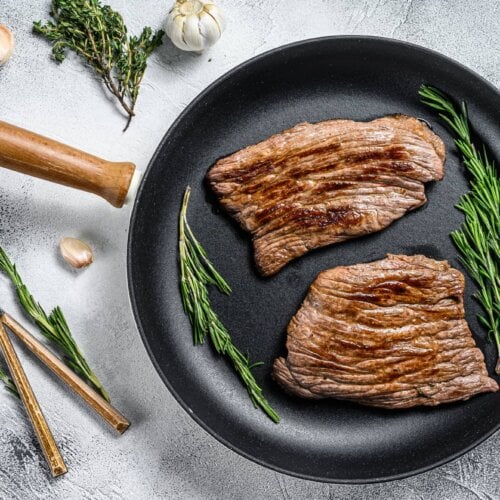
Flat iron steak comes from the muscled shoulder area of a cow. Although this area gets a workout, the way a butcher cuts flat iron keeps it surprisingly tender. However, it's still a relatively thin steak, so if you don't take care when cooking it, it can become tough pretty fast.
That's where knowing how to reverse sear flat iron steak can benefit you. This cooking method heats flat iron slowly in the oven to avoid overcooking while keeping an even temperature throughout. Then, you finish it with a pan sear.
Read our guide to learn more about cooking flat iron with the reverse sear method.
Taking a few minutes to prepare your workstation before reverse searing flat iron steak can boost your chances of success. Here's what to do:
Prepare flat iron steak for reverse searing by adding salt to both sides and letting it rest at room temperature for 45 minutes. Just before adding to the oven, sprinkle black pepper on both sides, too.
When your steak is close to the end of its resting time, preheat the oven to 200 degrees. Make sure one rack is in the middle slot in the oven. Spray cooking spray on a rimmed baking sheet.
Use a cast-iron skillet for searing if you have one. Add a drizzle of oil to the pan and heat it to medium-high heat. Allow it to heat completely before you add the steak.
To cook flat iron to medium-rare using reverse searing, you'll need about 20-30 minutes in the oven. Searing typically takes 2-6 minutes, followed by a resting time of five minutes before enjoying. For higher doneness levels, expect flat iron to take between 30-45 minutes in the oven.
The following chart can help you when taking the temperature of your steak after removing it from the oven and again after resting. Use the temperature ranges below for your desired doneness level as a guide.
| Steak Doneness | Temperature to Remove from Oven | Final Temperature |
| Medium-rare | 125°F-130°F | 130°F-135°F |
| Medium | 135°F-140°F | 140°F-145°F |
| Medium-well | 145°F-150°F | 150°F-155°F |
| Well-done | 155°F-160°F | 160°F-165°F |
Medium-rare is the ideal temperature for flat iron steak to prevent it from becoming to chewy. Cook flat iron in the oven at 200 degrees for 20 minutes, checking the temperature before searing to ensure that it reaches the medium-rare temperature range of 125°F-130°F. Sear for 1-3 minutes on each side and rest for five minutes.
Here are a few tips for getting the best results with reverse-seared flat iron steak.
If you love the flavor that marinades bring to steaks, flat iron is one of the best to use them on. If marinating your steak, let the steak sit in the marinade in the refrigerator for at least four hours or overnight before cooking. There's no need to salt the steaks before cooking if you use a marinade, but you should still leave them at room temperature for 45 minutes to an hour to bring their temperature up, allowing a more even cook.
We recommend using a lower-than-usual temperature to cook flat iron in the oven using the reverse sear method. More specifically, 200 degrees is the best option. This temperature allows for a slower cook, preventing flat iron from becoming overcooked during the process.
Always use a thermometer to check the temperature of your flat iron steak before removing it from the oven. Use the temperature chart above to ensure that your steak falls within the desired temperature range prior to searing.
Should you choose Wagyu or Premium Angus flat iron? How about dry-aged or wet-aged? The type of flat iron steak you choose can yield different results. We recommend selecting Premium Angus, USDA Prime, or Wagyu flat iron steak, with the latter two offering the best marbling and highest overall quality.
As for aged steaks, both wet and dry-aging create tasty and tender steaks, so you can't go wrong with either one. Generally, wet-aged flat iron is a bit lower in price because the wet-aging process is shorter than dry-aging.
Follow the steps below to learn how to reverse sear flat iron steak from start to finish.
About 45 minutes before you're ready to cook the flat iron steak, remove it from the refrigerator and add salt to both sides. Spray a baking sheet with a thin layer of cooking spray; set aside. Preheat the oven to 200 degrees 10 minutes before the resting time is done.
Sprinkle pepper on both sides of the steaks. Move them to the baking sheet and into the oven on the middle rack. Then, cook for 20 minutes. Check the temperature with a thermometer, comparing it to the temperature chart above. Allow to cook for another 10-20 minutes to your desired doneness level, if needed.
Heat a pan to medium-high heat. Add a drizzle of oil to the pan. Sear the steaks for 1-3 minutes on each side. When browned, transfer the steaks to a clean plate to rest for five minutes.
Serves: 2
Prep time: 45 minutes
Cooking time: 45 minutes-1 hour
Ingredients:
Instructions:
Per Serving (based on 3 servings, based on a 2,000-calorie daily diet)
| Nutrient | Amount (% Daily Value (DV)) |
|---|---|
| Calories | 470 (24%) |
| Total Fat | 34g (44%) |
| Saturated Fat | 13g (65%) |
| Trans Fat | 1g |
| Cholesterol | 120mg (40%) |
| Sodium | 560mg (24%) |
| Total Carbohydrate | 0g (0%) |
| Dietary Fiber | 0g (0%) |
| Total Sugars | 0g |
| Added Sugars | 0g (0%) |
| Protein | 39g (78%) |
| Vitamin D | 0.2mcg (1%) |
| Calcium | 20mg (2%) |
| Iron | 3.7mg (21%) |
| Potassium | 610mg (13%) |
There are pros and cons to any cooking method, but here's what to know about reverse searing flat iron steak:
Although reverse-searing and pan-searing are similar, they're not the same cooking methods. With pan-searing, you start by searing the steak in a skillet. Then, if it needs more time, you move it to the grill or oven to finish. Reverse-searing reverses those steps, starting the steak in the oven or on the grill and finishing it with a sear.
Main Course


Our guide to a slow-roasted prime rib for the holiday table.
Our guide to baking a ham for Christmas dinner.


Leave a comment
This site is protected by hCaptcha and the hCaptcha Privacy Policy and Terms of Service apply.