




How to slow-roast prime rib
Our guide to a slow-roasted prime rib for the holiday table.

Flat iron steak is one of the newer cuts to become mainstream. Cut from the shoulder area, it used to be considered a waste cut because it was too full of connective tissue to eat. However, experts have learned how to cut in a way that removes this connective tissue to reveal edible meat that's flavorful and, when cooked correctly, tender.
Sous vide helps get flat iron steak to an ideal tenderness by cooking it at a consistent temperature in water. Learn how to sous vide flat iron to get these delicious results to your table.
How do you choose quality flat iron steak? First, look for Premium Angus, USDA Prime, or Wagyu selections. These labels indicate the highest quality steaks you can buy based on marbling and overall quality. Also, find flat iron steaks labeled as wet-aged or dry-aged, a process that allows steaks to age over time in a controlled environment to enhance their texture and flavor. We have aged, high-quality flat iron steaks available for ordering online at Chicago Steak Company.
Opt for flat iron steaks that are uniform in thickness. This ensures that the steak cooks evenly during the sous vide process. Steaks with uneven thickness may result in some parts being overcooked while others are undercooked.
Before seasoning and vacuum sealing the flat iron steak, trim any excess fat or silver skin from the surface of the steak. This ensures that the seasoning can penetrate the meat evenly and prevents any undesirable chewiness.
Ensure the flat iron steak is placed in a single layer inside the vacuum-sealable bag, with no overlapping pieces. This allows for even cooking and ensures that the steak maintains its shape during the sous vide process. Remove as much air as possible from the bag before sealing to maximize contact between the steak and the water.
Pre-searing the flat iron steak before vacuum sealing can enhance flavor and create a deeper caramelization on the surface of the meat. Alternatively, you can opt for post-searing after sous vide cooking to develop a golden crust. Experiment with both methods to see which you prefer.
Your final steak temperature should reach between 130°F-135°F for medium-rare. It's important to remove the steps from the heat source when they are about 5 degrees F below your desired final internal temperature as the steaks continue to cook while they rest. Use the following chart as a guide for each level of doneness.
| Doneness Level | Description | Remove Steak From Heat Source at | Desired Final Internal Temperature |
|---|---|---|---|
| Rare | Red center, very juicy | 115-120°F / 46-49°C | 120-125°F (49-52°C) |
| Medium Rare | Pink center, warm and juicy | 125-130°F / 52-54°C | 130-135°F (54-57°C) |
| Medium | Pink center, slightly firm | 135-140°F / 57-60°C | 140-145°F (60-63°C) |
| Medium Well | Slight pink center, firm |
145-150°F / 63-66°C |
150-155°F (66-68°C) |
| Well Done | Brown throughout, very firm |
155°F / 68°C or lower |
160°F (71°C) or higher |
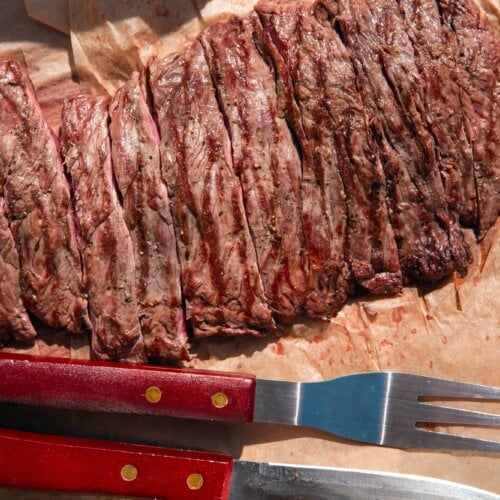
Many people prefer to slice flat iron after cooking it. If you choose to do so, be sure to cut it correctly. The right way to slice flat iron is against the grain, meaning that your knife should cut in the opposite direction as the lines that run through the steak. Start slicing only after you've allowed the steak to rest for 5-10 minutes to allow the meat to reabsorb its juices.
This is the core piece of equipment for sous vide cooking. A sous vide precision cooker heats and circulates water to maintain a precise temperature throughout the cooking process. There are various models available, ranging from immersion circulators to water ovens. Choose one that fits your budget and cooking needs.
You'll need a container or pot large enough to hold water for sous vide cooking. Many people use a dedicated sous vide container, which is designed to hold a sous vide precision cooker securely. Alternatively, you can use a large pot or plastic container, as long as it's heat-resistant and large enough to accommodate your steak and immersion circulator.
You'll need food-grade bags suitable for sous vide cooking. Vacuum-sealable bags are designed for use with vacuum sealers and provide a tight seal. Alternatively, you can use sturdy, food-grade zipper-lock bags for the water displacement method.
To prevent floating and ensure that the steak stays fully submerged in the water bath, you may need sous vide weights. These can be specialized weights designed for sous vide cooking or simply heavy kitchen items like ceramic tiles or stainless steel utensils.
Per Serving (based on 4 servings, based on a 2,000-calorie daily diet)
| Nutrient | Amount (% Daily Value (DV)) |
|---|---|
| Calories | 460 (23%) |
| Total Fat | 33g (42%) |
| Saturated Fat | 12g (60%) |
| Trans Fat | 1g |
| Cholesterol | 120mg (40%) |
| Sodium | 410mg (18%) |
| Total Carbohydrate | 0g (0%) |
| Dietary Fiber | 0g (0%) |
| Total Sugars | 0g |
| Added Sugars | 0g (0%) |
| Protein | 38g (76%) |
| Vitamin D | 0.2mcg (1%) |
| Calcium | 18mg (1%) |
| Iron | 3.6mg (20%) |
| Potassium | 610mg (13%) |
Main Course


Our guide to a slow-roasted prime rib for the holiday table.
Our guide to baking a ham for Christmas dinner.


Leave a comment
This site is protected by hCaptcha and the hCaptcha Privacy Policy and Terms of Service apply.