




How to slow-roast prime rib
Our guide to a slow-roasted prime rib for the holiday table.

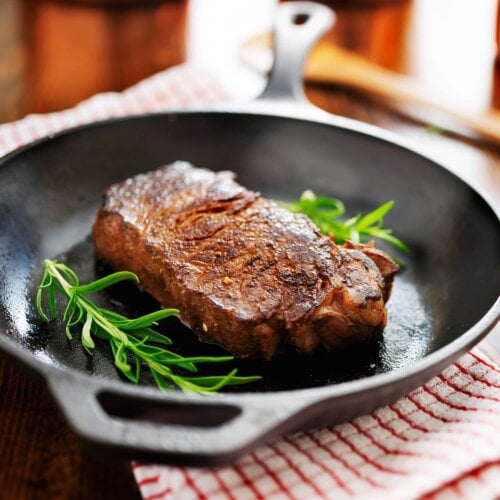
Strip steak is a steakhouse staple, and it might even be a common addition to your favorite dinner recipes at home. But instead of grilling it or pan searing it, have you tried the reverse sear method?
If not, continue reading our guide to learn how to reverse sear strip steak. Once you try its perfect sear and tender bite, you might never go back to the grill again.
Let's look at how to prepare for reverse searing strip steak:
First, get the steak ready. Remove it from the refrigerator and salt it generously on both sides. Then, let it rest at room temperature for 45 minutes to an hour to brine, which helps it crisp and tenderize.
Get a cast-iron skillet ready to heat when your steak is almost done in the oven. Drizzle a small amount of olive oil in the pan while heating.
When there are about 10 minutes left on the steak resting time, preheat the oven to 225 degrees, making sure an oven rack is in the middle position. Spray a rimmed baking sheet with cooking spray.
Strip steak takes about 20-30 minutes to cook in the oven before it's ready to sear if you're cooking to medium-rare. Higher levels of doneness might need closer to 45 minutes or even an hour in the oven.
We've created the temperature chart below to help you find the best temperature range for strip steaks when reverse-searing. For medium-rare, the steak should reach 125°F-130°F after cooking in the oven and 130°F-135°F after searing and resting.
| Steak Doneness | Temperature to Remove from Oven | Final Temperature |
| Medium-rare | 125°F-130°F | 130°F-135°F |
| Medium | 135°F-140°F | 140°F-145°F |
| Medium-well | 145°F-150°F | 150°F-155°F |
| Well-done | 155°F-160°F | 160°F-165°F |
We recommend reverse searing strip steak to medium-rare by preheating the oven to 225 degrees and cooking for 20 minutes. Temp the steak with a thermometer and, if needed, place back in the oven for a few more minutes until it reaches 125°F-130°F. Then, sear in a hot skillet with oil for 2-3 minutes on each side. Rest for 5-10 minutes while loosely tented with foil before enjoying.
Below, we've outlined a few tips to help you reverse sear strip steak:
Because strip steak can be on the thin side, you don't want to leave it in the oven too long, as it can overcook quickly. Check the steak after 20 minutes in the oven if cooking to medium-rare or medium to see if it's reached the appropriate temperature range. You can always add it back to the oven if needed for a few minutes. Use a thermometer to accurately gauge the temperature by inserting the probe into the thickest part of the steak.
In this guide, we walk you through the steps of reverse searing strip steak using your oven. However, you can still use the grill if you prefer. To do this, set the grill to 225 degrees or low flames. Check the steak after 20 minutes, but it may need extra time on the grill, depending on what type of grill you have. Then, sear as usual on the stove.
There are a few different types of strip steaks you might find in the store. Here's a quick guide on what to consider for reverse searing:
Learn how to reverse sear strip steak using the steps below:
Leave steaks at room temperature for at least 45 minutes before cooking. Right after removing them from the refrigerator, salt them generously on both sides.
Meanwhile, preheat the oven to 225 degrees with an oven rack moved to the middle position. Spray a baking sheet lightly with cooking spray.
Transfer the steaks to the baking tray and then into the oven. Cook for 20-30 minutes, using a thermometer to check the temperature after 20 minutes.
Heat a skillet to medium-high heat. Sear steaks for 2-3 minutes on each side until golden brown. Check the temperature again after searing using the temperature chart above.
Move steaks to a clean plate or cutting board. Loosely tent foil over the steaks as they rest for 5-10 minutes. Then, slice against the grain and serve.

Serves: 2
Prep time: 45 minutes
Cooking time: 45 minutes-1 hour
Ingredients:
Instructions:
Per Serving (based on 2 servings, based on a 2,000-calorie daily diet)
| Nutrient | Amount (% Daily Value (DV)) |
|---|---|
| Calories | 610 (31%) |
| Total Fat | 44g (56%) |
| Saturated Fat | 16g (80%) |
| Trans Fat | 2g |
| Cholesterol | 135mg (45%) |
| Sodium | 500mg (22%) |
| Total Carbohydrate | 0g (0%) |
| Dietary Fiber | 0g (0%) |
| Total Sugars | 0g |
| Added Sugars | 0g (0%) |
| Protein | 46g (92%) |
| Vitamin D | 0.3mcg (2%) |
| Calcium | 22mg (2%) |
| Iron | 4.0mg (22%) |
| Potassium | 640mg (14%) |
Strip steak typically fares well with reverse searing, but it this method also has its downsides. Here's what to expect:
Pan-searing requires you first to sear a steak in a pan. Thinner steaks sometimes only need time in the pan to cook to your liking, while thicker ones could need more time in an oven to finish. Reverse-searing always uses an oven to start, bringing the steak to your ideal temperature before searing it in the pan. So, the two methods are basically opposites.
Main Course


Our guide to a slow-roasted prime rib for the holiday table.
Our guide to baking a ham for Christmas dinner.


Leave a comment
This site is protected by hCaptcha and the hCaptcha Privacy Policy and Terms of Service apply.